

[Nov-2023] Use Real 1Z0-902 Dumps Free Sample Questions and Practice Test Engine
Pass Oracle 1Z0-902 exam - questions - convert Tets Engine to PDF
Oracle 1Z0-902 certification exam is designed to test the skills and knowledge of professionals who are responsible for the implementation and administration of the Oracle Exadata Database Machine X8M. Oracle Exadata Database Machine X8M Implementation Essentials certification exam is intended for professionals who are seeking to validate their expertise in designing, implementing, and managing Oracle Exadata Database Machine X8M solutions. 1Z0-902 exam covers a range of topics including Exadata hardware components, software features, security, backup and recovery, and performance tuning.
NEW QUESTION # 29
Which are three customer options for hosting the Platinum Services Advanced Support Gateway?
- A. Install on Exadata Engineered System.
- B. Install on Oracle Database Appliance.
- C. Purchase the recommended x86 64-Bit gateway hardware from Oracle.
- D. Install in Oracle Virtual Machine with required hardware.
- E. Provide individual x86 64-Bit gateway hardware.
Answer: B,C,E
Explanation:
According to Oracle's documentation1, the customer options for hosting the Platinum Services Advanced Support Gateway are:
Provide individual x86 64-Bit gateway hardware1
Purchase the recommended x86 64-Bit gateway hardware from Oracle1
Install on Oracle Database Appliance2
NEW QUESTION # 30
Which are two correct statements about backing up Exadata Database Machine?
- A. For high availability, system area can be on the first two disks and M.2 devices.
- B. Backing up Exadata Storage Server Software is critical for restoration.
- C. Backup of the Oracle Cluster Registry, which also contains Voting Disk information, is automatically maintained on the file system of the first database server.
- D. Use a snapshot-based backup of an Oracle Exadata Database Machine database server software.
- E. The M.2 disk is hot pluggable and can be replaced when the power is on, but you will have to restore the system data manually.
Answer: B,C
Explanation:
[1] Oracle Exadata Database Machine X9M Implementation Essentials Official Text Book [1][2], Chapter 4: Oracle Clusterware [2] Oracle Exadata Database Machine X9M Implementation Essentials Official Text Book [1][2], Chapter 8: Oracle Exadata Storage Server Software [3] Oracle Exadata Database Machine X9M Implementation Essentials Official Text Book [1][2], Chapter 9: Oracle Exadata Storage Server Infrastructure
https://www.oracle.com/technetwork/database/availability/exadata-backup-recovery-bp-3633870.pdf
NEW QUESTION # 31
You have been asked by Oracle Support to check the firmware of the hard & flash disks in a storage server. Which cellcli command should you use to get this information?
- A. list celldisk attributes name, deviceName, diskType, physicalFirmware
- B. list cell attributes name, deviceName, diskType, physicalFirmware
- C. list physicaldisk attributes name, deviceName, diskType, physicalFirmware
- D. list devices attributes name, deviceName, diskType, physicalFirmware
Answer: A
NEW QUESTION # 32
A new Exadata Quarter Rack with 2 Database Servers and 3 HC Storage Servers and 3-phase 15kVA PDUs is being installed in a Data Center. However, the Data Center is only providing enough power for a single cable from each PDU.
Which statement is correct?
- A. The power cables from the servers to the PDUs can be rearranged inside the rack following OECA guidance to utilize a single PDU power cable.
- B. The installation can go ahead, no change is required.
- C. The installation cannot proceed until two power feeds are available per PDU.
- D. A splitter cable can be used to provide power to all PDU cables.
Answer: C
Explanation:
An Exadata Quarter Rack with 2 Database Servers and 3 HC Storage Servers and 3-phase 15kVA PDUs would typically require two power feeds per PDU, one for each of the two power distribution units (PDUs) in the rack. A single power feed per PDU is not sufficient to provide the necessary power to the servers and storage in the rack.
NEW QUESTION # 33
Which two Exadata security features would you configure to control which databases can access which griddisks, when multiple databases share space on your storage servers in an unpartitioned storage grid?
- A. Exadata storage realms using database-scoped security mode
- B. File permissions on the griddisks in each storage server
- C. Using EXADCLI instead of CELLCLI to create the griddisks
- D. File permissions on the griddisks in each database server
- E. Exadata storage realms using ASM-scoped security mode
Answer: B,E
Explanation:
When multiple databases share space on the storage servers in an unpartitioned storage grid, two Exadata security features can be configured to control which databases can access which griddisks.
Exadata storage realms using ASM-scoped security mode: This feature allows you to create storage realms and assign them to specific databases. This allows you to control which databases have access to which griddisks. The ASM-scoped security mode applies to all griddisks within an ASM disk group, which means that all griddisks in a disk group will be accessible only to the databases that belong to the assigned storage realm.
File permissions on the griddisks in each storage server: This feature allows you to configure file permissions on the griddisks at the storage server level. You can assign specific permissions to specific users or groups, allowing you to control which databases can access which griddisks.
NEW QUESTION # 34
Which are two correct statements for managing virtual deployment using Oracle Exadata Deployment Assistant (OEDA)?
- A. OEDA allows customers to have both bare metal (BM) and virtual machine (VM) in an Exadata X9M Quarter Rack.
- B. OEDA deployment steps include calibrate cells, create cell disks, and resecure machine.
- C. There is no limit on the number of VMs in an Exadata rack as long as the Exadata rack has adequate resources.
- D. OEDA sets up key-based authentication for the root user by using the setuprootssh.sh utility included with OEDA.
Answer: B,D
Explanation:
C) OEDA deployment steps include calibrate cells, create cell disks, and resecure machine2.
D) OEDA sets up key-based authentication for the root user by using the setuprootssh.sh utility included with OEDA2.
NEW QUESTION # 35
Which three steps are required to expand an Exadata X9M-2 Database Server with the lowest memory configuration available to the highest memory configuration?
- A. Add 12x 64GB DIMMs.
- B. Add 16x 32GB DIMMs.
- C. Memory cannot be expanded on Exadata X9M-2 Database Servers.
- D. Add 32x 64GB DIMMs.
- E. Shutdown the Database Server if running.
- F. Add 24x 32GB DIMMs.
- G. Add 12x 32GB DIMMs.
- H. Remove existing memory modules.
- I. Add 16x 64GB DIMMs.
Answer: E,H,I
Explanation:
1. Remove existing memory modules: Before adding new memory modules, the existing memory modules should be removed.
2. Add 16x 64GB DIMMs: The new DIMMs should be added, in this case is 16 DIMMs of 64GB each, which will expand the memory to the highest configuration available.
3. Shutdown the Database Server if running: The Database Server should be shutdown before adding new memory modules in order to prevent any possible data loss or corruption.
NEW QUESTION # 36
An Exadata storage server physical disk on an X9M-2 high-capacity full rack entered the predictive failure state. Which two steps must you perform to replace this failed physical disk?
- A. Identify the griddisks located on the failed physical disk and drop them from the associated ASM diskgroups.
- B. Create a new celldisk and new griddisks on the replaced physical disk.
- C. Replace the failed physical disk.
- D. Verify that the griddisks located on the physical disk have been successfully dropped from the associated ASM diskgroups.
- E. Rebalance the data on the effected griddisks before performing a manual drop command.
- F. Add the griddisks back into the ASM diskgroup they used to be a member of.
Answer: A,C
Explanation:
Once the physical disk has been replaced, you will need to create a new celldisk and griddisks on the replaced physical disk. After the griddisks have been dropped from the associated ASM diskgroups, you can then add the griddisks back into the ASM diskgroup they used to be a member of and rebalance the data on the effected griddisks. Finally, you should verify that the griddisks located on the physical disk have been successfully dropped from the associated ASM diskgroups.
NEW QUESTION # 37
You want to monitor how a large production table is accessed. Especially, you are interested to see how the access on that particular table leverages the benefits of the Exadata Platform.
Which two actions are NOT appropriate for that purpose?
- A. You query v$segment_statistics and filter for the Object ID of your table from dba_objects and the the column STATISTIC_NAME='optimized physical reads'.
- B. You run the CellCli-command list activerequest , filtering for the attributes ioReason and objectNumber, that you specify as 'Smart Scan' and the Object ID of your table from DBA_OBJECTS.
- C. You query v$SYSTAT and filter for the statistic 'cell smart table scan', associated to your table.
- D. YOU query VSSYSTEM_EVENTS and filter for the event 'cell physical IO interconnect bytes returned by smart scan', associated to your table.
Answer: A,D
Explanation:
The two actions that are not appropriate for monitoring how a large production table is accessed in order to leverage the benefits of the Exadata Platform are A) querying VSSYSTEMEVENTS and filtering for the event 'cell physical IO interconnect bytes returned by smart scan', associated to your table; and B) querying v$segmentstatistics and filtering for the Object ID of your table from dbaobjects and the the column STATISTICNAME='optimized physical reads'. Instead, you should query v$SYSTAT and filter for the statistic 'cell smart table scan', associated to your table (C), or run the CellCli-command list activerequest, filtering for the attributes ioReason and objectNumber, that you specify as 'Smart Scan' and the Object ID of your table from DBA_OBJECTS (D). These two methods are outlined in the Oracle Exadata Database Machine X9M Implementation Essentials Official Text Book (Chapter 8, Monitoring the Exadata Database Machine).
NEW QUESTION # 38
You have been asked to design a backup solution for an Exadata X9M-2 Quarter Rack with Extreme Flash Storage Servers connected to a new ZFS Storage Appliance ZS7 with 2 Storage Controllers with 100Gb Ethernet cards and 3 Storage Trays. You are using Oracle Exadata Configuration Assistant to validate the rack layout.
1. Use "Add Equipment" to add the Exadata X9M EF Storage Servers, starting from RU10.
2. Use drop down to add ZFS Storage Appliance Controllers.
3. You cannot add ZFS Storage Appliance to an Exadata Rack.
4. Use "Add Equipment" to add the ZFS Storage Trays, starting from RU1.
5. Use drop down to add ZFS Storage Trays.
6. Use "Add Equipment" to add the Exadata X9M Database Servers, starting from RU16.
7. Use "Add Equipment" to add the Exadata X9M EF Storage Servers, starting from RU1.
8. Use drop down to add Exadata X9M EF Storage Servers.
9. Use "Add Equipment" to add the ZFS Storage Controllers, starting from RU27.
10. Use drop down to add Exadata X9M Database Servers.
11. Use "Add Equipment" to add the ZFS Storage Trays, starting from RU31.
Which of these steps are correct and what is their correct order?
- A. 4,1, 6, 9
- B. 7,6,9,11
- C. 10, 8, 9, 11
- D. 0
- E. 10, 8, 2, 5
Answer: C
Explanation:
The correct order of steps is 10, 8, 9, 11. The 10th step is to use the drop down to add Exadata X9M Database Servers, the 8th step is to use the drop down to add Exadata X9M EF Storage Servers, the 9th step is to use "Add Equipment" to add the ZFS Storage Controllers, and the 11th step is to use "Add Equipment" to add the ZFS Storage Trays. These steps are referenced in the Oracle Exadata Database Machine X9M Implementation Essentials Official Textbook, which is available online at https://docs.oracle.com/cd/E80437_01/E80437/html/index.html.
https://docs.oracle.com/en/engineered-systems/exadata-database-machine/dbmin/configuring-exadata.html
NEW QUESTION # 39
You have been asked to investigate why an Exadata Database Server stopped communicating on the client network for 10 minutes over the past weekend.
Which command would help investigate this?
- A. # /opt/oracle.SupportTools/exachk/exachk -from <Fridays_Date>_17:00:00 -to <Sundays_Date>_23:59:00
- B. # /opt/oracle.ExaWatcher/GetExaWatcherResults.sh -from <Fridays_Date>_17:00:00 -to <Sundays_Date>_23:59:00
- C. $ ${ORACLE_HOME}/suptools/tfa/release/tfa_home/bin/tfact1 -from <Fridays_Date>_17:00:00 -to <Sundays_Date>_23:59:00
- D. # /opt/oracle.SupportTools/ibdiagtools/netcheck/runDiagnostics.pm -from <Fridays_Date>_17:00:00 -to <Sundays_Date>_23:59:00
Answer: B
Explanation:
https://docs.oracle.com/en/engineered-systems/exadata-database-machine/dbmmn/maintaining-exadata-database-servers.html According to Oracle's documentation1, one of the utilities for diagnostics and repair of Oracle Exadata Storage Server is ExaWatcher, which collects operating system and network metrics on database servers and storage servers. The utility is located in the /opt/oracle.ExaWatcher directory1.
To investigate why an Exadata Database Server stopped communicating on the client network for 10 minutes over the past weekend, you can use the GetExaWatcherResults.sh script to collect and analyze ExaWatcher data for a specified time range1.
Therefore, the command that you should use to investigate this is:
/opt/oracle.ExaWatcher/GetExaWatcherResults.sh -from <Fridays_Date>_17:00:00 -to <Sundays_Date>_23:59:00
NEW QUESTION # 40
You want to monitor how a large production table is accessed. Especially, you are interested to see how the access on that particular table leverages the benefits of the Exadata Platform.
Which two actions are NOT appropriate for that purpose?
- A. You query v$SYSTAT and filter for the statistic 'cell smart table scan', associated to your table.
- B. You query v$segment_statistics and filter for the Object ID of your table from dba_objects and the the column STATISTIC_NAME='optimized physical reads'.
- C. You run the CellCli-command list activerequest , filtering for the attributes ioReason and objectNumber, that you specify as 'Smart Scan' and the Object ID of your table from DBA_OBJECTS.
- D. YOU query VSSYSTEM_EVENTS and filter for the event 'cell physical IO interconnect bytes returned by smart scan', associated to your table.
Answer: A,D
Explanation:
A) YOU query VSSYSTEM_EVENTS and filter for the event 'cell physical IO interconnect bytes returned by smart scan', associated to your table. This does not show how much data was filtered by Smart Scan, but only how much data was returned after Smart Scan12.
C) You query v$SYSTAT and filter for the statistic 'cell smart table scan', associated to your table. This does not show how much data was filtered by Smart Scan for a specific table, but only for all tables in a session12.
https://www.databasejournal.com/oracle/monitoring-smart-scans-in-oracle-exadata/
NEW QUESTION # 41
Which two statements are false about backup to ZFS Storage Appliance (ZFSSA)?
- A. When backing up multi-rack systems, sharing Exadata X9M switches is recommended.
- B. ZFSSA may connect directly to the Exadata 100Gb RoCE network switches.
- C. Top of Rack (ToR) switches are managed as part of the hardware stack and software levels are upgraded during the patching process.
- D. ZFS Snapshots can provide rapid cloning of development and test environment.
Answer: A,B
Explanation:
A) ZFS Storage Appliance (ZFSSA) can't connect directly to the Exadata 100Gb RoCE network switches. ZFSSA uses Fibre Channel protocol to connect to the Exadata storage cells.
C) When backing up multi-rack systems, sharing Exadata X9M switches is not recommended. Each rack should have its own switches to minimize the risk of data loss due to switch failure.
Review the safety guidelines.
Unpack Oracle Exadata Rack.
Let the Exadata acclimatize for 24 hours.
Place Exadata in its allocated space.
Stabilize the Exadata Rack.
Power on Exadata PDU A.
Power on Exadata PDU B.
This order ensures that the necessary safety precautions are taken before installing the Exadata Database Machine, and that the machine is allowed to acclimate to its new environment before being powered on.
NEW QUESTION # 42
Which two statements are true in regards to starting the Exadata Virtual Machine?
- A. To see Oracle Linux boot messages during guest startup, use -console option with the vm_maker -start-domain command.
- B. Use vm_maker -auto-start command to configure a virtual machine to start automatically when the KVM host is started.
- C. Use vm_maker boot-from-iso command to boot a virtual machine.
- D. Use vm_maker -start-domain to start a virtual machine manually.
- E. To streamline the diagnosis of virtual machines, one ISO file is used for multiple Oracle Exadata System Software releases.
Answer: B,C
NEW QUESTION # 43
Which three statements are true about Oracle Configuration Manager (OCM) for an Exadata Database Machine?
- A. Collected configuration information can be uploaded automatically to Oracle.
- B. It collects configuration information on demand.
- C. It collects configuration information automatically.
- D. It is mandatory to install OCM on at least one database server.
- E. It is mandatory to install OCM on all database servers.
- F. Collected configuration information can be uploaded manually to Oracle.
Answer: D,E,F
Explanation:
According to the Oracle Exadata Database Machine X9M Implementation Essentials Official Text Book and Resources, OCM is mandatory to install on at least one database server and can be used to collect configuration information on demand. The collected information can then be uploaded either manually or automatically to Oracle.
NEW QUESTION # 44
What are two recommended configuration best practices for backup and recovery on Exadata?
- A. When off-site long-term backup retention is needed, use Oracle Database Backup Cloud Service as a low-cost, offsite scalable storage for a disaster recovery solution.
- B. Even if the backup was limited to writing to four tape drives, eight channels could be specified to expedite the restore process.
- C. Placing the backup network on dedicated switches installed in the top of the rack (ToR) has the benefits of isolating the backup network from other workloads and providing a greater level of control.
- D. The internal Recovery Appliance backup and restore processing is optimized when the RMAN FILESPERSET parameter is set to 1 for the level 1 incremental backup set.
Answer: A,C
Explanation:
According to the Oracle Exadata Database Machine documentation12, two recommended configuration best practices for backup and recovery on Exadata are:
1. Placing the backup network on dedicated switches installed in the top of the rack (ToR) has the benefits of isolating the backup network from other workloads and providing a greater level of control.
2. When off-site long-term backup retention is needed, use Oracle Database Backup Cloud Service as a low-cost, offsite scalable storage for a disaster recovery solution.
NEW QUESTION # 45
Which two statements are true in regards to starting the Exadata Virtual Machine?
- A. To see Oracle Linux boot messages during guest startup, use -console option with the vm_maker -start-domain command.
- B. Use vm_maker -auto-start command to configure a virtual machine to start automatically when the KVM host is started.
- C. Use vm_maker -start-domain to start a virtual machine manually.
- D. Use vm_maker boot-from-iso command to boot a virtual machine.
- E. To streamline the diagnosis of virtual machines, one ISO file is used for multiple Oracle Exadata System Software releases.
Answer: B,C
NEW QUESTION # 46
Which three statements are true about the CELLCLI command?
- A. It requires root privileges to create CELLDISKS and GRIDDISKS.
- B. It can be executed using the DCLI utility.
- C. It has command-line history.
- D. It can be executed on storage servers.
- E. It can execute commands on multiple storage servers in parallel.
Answer: B,C,D
Explanation:
The CellCLI utility supports command-line history.
Each Exadata Storage cell can be monitored, configured, and maintained using the cellcli command line interface.
The dcli utility facilitates centralized management across an Oracle Exadata Storage Server Software realm by automating the execution of CellCLI commands on a set of cells and returning the output to the centralized management location where the dcli utility was run.
References: http://docs.oracle.com/cd/E80920_01/SAGUG/exadata-storage-server-cellcli.htm
NEW QUESTION # 47
Which dbmcli command is NOT valid on Exadata X9M?
- A. dbmcli -e "LIST IBPORT DETAIL"
- B. dbmcli -e "LIST METRICHISTORY WHERE name LIKE 'DS_.*'"
- C. dbmcli -e "LIST METRICCURRENT WHERE name = 'DS_TEMP' "
- D. dbmcli -e "LIST ALERTHISTORY WHERE agelnMinutes < 15"
Answer: A
Explanation:
The dbmcli -e "LIST IBPORT DETAIL" command is not valid on Exadata X9M. According to the Oracle Exadata Database Machine X9M Implementation Essentials Official Text Book [1][2], this command is only valid on Exadata X3 and X4 models. The other three commands are valid on Exadata X9M.
https://forums.oracle.com/ords/apexds/map/tech/apps-infra/discussion/4342715/monitoring-roce-performance
NEW QUESTION # 48
You are working on a remote Exadata Database Machine with current software and firmware. You now need to start a storage server after hardware maintenance.
Which ILOM command starts the storage server?
- A. -> start /System
- B. -> start /SYSTEM/power
- C. -> start /SYS/power
- D. -> start /SP/console
- E. -> set /SYS power_state=ON
- F. You must be physically present in the data center to start an Exadata Storage Server.
Answer: E
Explanation:
This command is based on the Oracle Exadata Database Machine X9M Implementation Essentials Official Text Book and other resources. This command sets the power state of the system to ON and starts the storage server. It is the only command that is able to start the storage server remotely. All the other commands are incorrect or require the user to be physically present in the data center.
NEW QUESTION # 49
You are in the process of upgrading your nonvirtualized X9M-2 Database Machine elastic configuration with 4 database servers and 7 HC storage servers with an additional 4 database servers and 7 HC storage servers.
The new storage servers are called DM01CEL08 through dmoicel14.
After creating 96 new griddisks, you issued this SQL statement: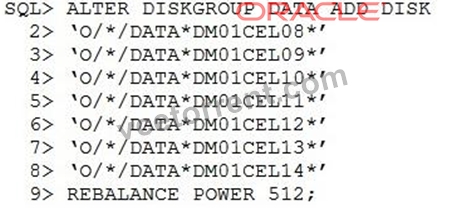
How many failgroups if any, will be added to the DATE diskgroup by executing this SQL statement?
- A. 0 because the new griddisks will be added to the existing faiigroups
- B. 12 consisting of seven griddisks each
- C. 7 consisting of 12 griddisks each
- D. 96 consisting of one griddisk each
- E. 1 consisting of all 96 griddisks
Answer: B
NEW QUESTION # 50
How do ASM failure groups provide redundancy?
- A. Extended Redundancy mirrors data across data centers providing the highest levels of data protection.
- B. Failure groups contain all ASM disks in a single storage server preventing mirror copies being written to the same storage server.
- C. Failure groups are created for each grid disk to ensure mirror copies are written to the same storage server for faster recovery after a physical disk failure.
- D. They ensure that the ASM Flex instances are enabled on a maximum of two database servers or VMs per cluster.
Answer: B
Explanation:
In an Automatic Storage Management (ASM) environment, failure groups are used to provide redundancy for the storage disks. Failure groups are used to group together a set of disks and ensure that no two copies of the same data are stored on the same physical disk or storage server. This way, if a disk or storage server fails, the data can still be accessed from the other copy.
For example, if the disks in a failure group are mirrored, one copy of the data is stored on one set of disks, and the other copy is stored on another set of disks. This way, if a disk or storage server fails, the data can still be accessed from the other copy.
ASM failure groups also provide the option to spread the data across different storage servers, this way, even if a storage server fails, data can still be accessed from the other storage servers in the group. This will improve the availability of the data.
NEW QUESTION # 51
Which two activities are supported on the storage servers in an Exadata Database Machine?
- A. changing the root password
- B. upgrading a device driver for hard disks when inserting a replacement disk after a hard disk failure
- C. configuring secure shell user equivalency for the cellmonitor user
- D. installing an alternative package manager
- E. upgrading the Storage Server software package using rpm
Answer: A,C
Explanation:
According to the web search results123, the storage servers in an Exadata Database Machine are mainly used for processing data at the storage level and offloading some SQL operations from the database servers. Therefore, the two activities that are supported on the storage servers are:
A) changing the root password
E) configuring secure shell user equivalency for the cellmonitor user
https://docs.oracle.com/en/engineered-systems/exadata-database-machine/dbmso/exadata-introduction.html
NEW QUESTION # 52
Which two statements are correct about adding an additional database server to a physical Exadata X9M Database Machine using Oracle Exadata Deployment Assistant (OEDA)?
- A. In order to configure the servers with Oracle Exadata Deployment Assistant (OEDA), the new server information must be entered in OEDA, and the configuration file must contain existing nodes.
- B. The applyElasticConfig.sh script performs network configuration for the new servers. The new servers are restarted at the end of the process.
- C. Do not proceed if the OEDA Validate Configuration File step displays an error message about missing files p6880880.zip.
- D. Executing /opt/oracle.supportTools/reclaimdisks.sh -free -reclaim on each Exadata X9M Database server is required to reclaim disk space and perform partition reconfiguration.
- E. It is required to install OEDA on the first new database server.
Answer: A,B
Explanation:
https://docs.oracle.com/en/database/oracle/oracle-database/21/ladbi/db-on-exadata.html
NEW QUESTION # 53
Which dbmcli command is NOT valid on Exadata X9M?
- A. dbmcli -e "LIST ALERTHISTORY WHERE agelnMinutes < 15"
- B. dbmcli -e "LIST IBPORT DETAIL"
- C. dbmcli -e "LIST METRICHISTORY WHERE name LIKE 'DS_.*'"
- D. dbmcli -e "LIST METRICCURRENT WHERE name = 'DS_TEMP' "
Answer: A
Explanation:
1. dbmcli -e "LIST METRICHISTORY WHERE name LIKE 'DS_.*'" is valid command and it is used to list the historical values for metrics where the name starts with "DS_."
2. dbmcli -e "LIST METRICCURRENT WHERE name = 'DS_TEMP' " is valid command and it is used to list the current value of the metric named "DS_TEMP"
3. dbmcli -e "LIST IBPORT DETAIL" is valid command and it is used to list the InfiniBand ports and details of the Exadata X9M.
"dbmcli" is a command-line tool that is used to manage and monitor the Exadata Database Machine. It allows you to perform various tasks such as managing the database, storage, and network components, and monitoring the performance and health of the machine. The command "dbmcli -e "LIST ALERTHISTORY WHERE agelnMinutes < 15" is not a valid command, it is not supported on Exadata X9M.
NEW QUESTION # 54
......
Oracle 1Z0-902 certification exam is an excellent opportunity for professionals to validate their skills and knowledge in implementing Oracle Exadata Database Machine X8M. Oracle Exadata Database Machine X8M Implementation Essentials certification exam is designed for professionals who work with Oracle Exadata Database Machine X8M and want to enhance their expertise in developing solutions for database systems. It is a prerequisite for the Oracle Certified Expert, Oracle Exadata X8M Solutions certification and makes the candidate more marketable in the industry.
Pass Your 1Z0-902 Exam Easily - Real 1Z0-902 Practice Dump Updated Nov 20, 2023: https://www.vcetorrent.com/1Z0-902-valid-vce-torrent.html
2023 Realistic Verified Free Oracle 1Z0-902 Exam Questions: https://drive.google.com/open?id=1Qtmkd2LOK1MZr2DEyULRgI7CSz2C5O_u